This article is for businesses registered for GST. Registration is compulsory once your GST turnover reaches $75,000 ($150,000 for not-for-profits, and from the first dollar if you drive taxi or rideshare), and voluntary below that. If you’re not registered, you don’t charge GST, you can’t claim it back, and you won’t lodge a BAS for it. If you have employees or pay PAYG instalments, you’ll still be lodging an instalment activity statement, and the second half of this article applies to you.
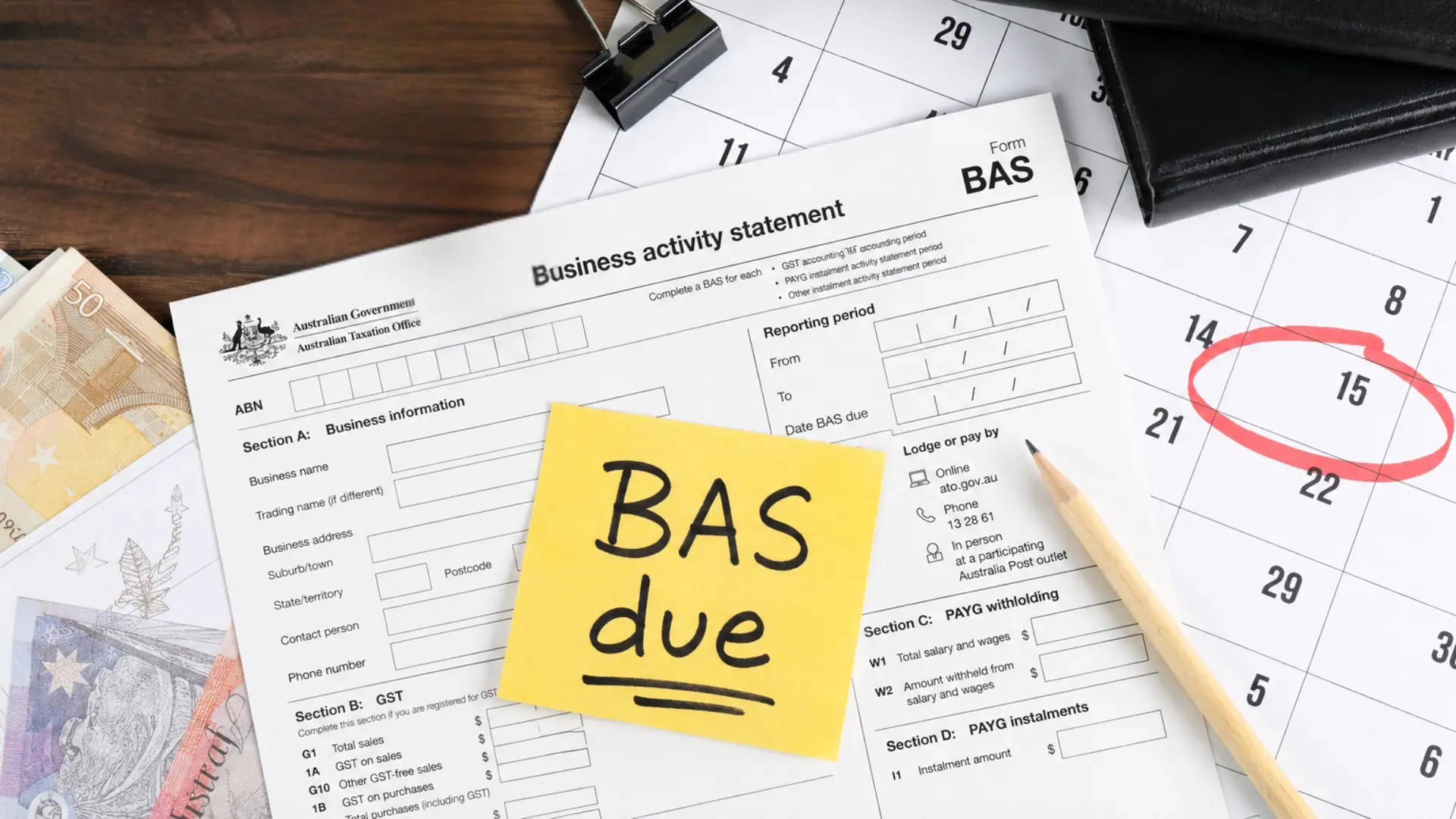
A Business Activity Statement (BAS) isn’t a bill in the ordinary sense. It’s a tax reporting form sent to the Australian Taxation Office (ATO). Most of what’s on your BAS is money that was never yours to begin with.
The amount you owe – or get back – is the result of several different things happening in your business. Your BAS brings them together, including the GST collected and paid, PAYG withholding and PAYG instalments.
So, what are they each telling you?
GST: When you charge a customer $1,100 including GST, $100 of that belongs to the ATO. You’re collecting it from the customer and passing it on to them. Your BAS works out the difference between the GST you’ve collected on sales and the GST you’ve paid on purchases, and you pay or receive the difference.
PAYG withholding: This is the tax you deduct from your employees’ wages and hold until you pass it on to the ATO. Like the GST, it was never your money.
PAYG instalments. This one confuses people most. These are prepayments towards your own income tax for the current year. They’re based on what you earned last year and are credited against your assessment when your return is lodged. If you’ve paid too much, you get the excess back. If you’ve paid too little, you’ll have more to pay at tax time.
Cash or accruals: which accounting method are you using?
You choose your GST accounting method when you register your business, and it’s easy to forget about it once you’re up and running. There are two ways to account for GST: cash and accruals.
Cash basis means you account for GST when the money actually moves. You don’t report GST on a sale until the customer has paid you, and you don’t claim the GST credit on a purchase until you’ve paid the supplier. Businesses with aggregated turnover under $10 million can generally choose this method.
Accruals basis means you account for GST when the invoice is issued or received, regardless of when the money changes hands. Above that threshold you’ll generally be required to use accruals.
Picking the right method
Which method works best depends on how money flows through to your business.
Cash usually wins if your customers are slow
If your business trades on 30- or 60-day terms, if you usually have subcontractors waiting on progress claims, or if your consultants are constantly chasing debtors, you could be paying GST before you’ve received the money.
On an accruals basis, you remit the GST when you invoice the customer, even if you’re still waiting to be paid. This means you end up funding your customer’s GST out of your own working capital.
On cash, that problem disappears, as you don’t account for the GST until the money moves.
Accruals can suit you if you’re paid quickly and pay suppliers slowly
Retail, hospitality and e-commerce take the money at the point of sale but often buy stock on terms, meaning they can pay their suppliers later. On accruals, you can claim the GST credit on a supplier bill in the quarter you receive it, before you’ve actually paid for it.
The other benefit of accruals is that it also matches your reporting. Your P&L is prepared on accruals, so your BAS and management accounts reconcile without a bridging exercise. Some owners value that more than the cash timing.
If your business has changed shape since you registered – you have longer debtor terms, a shift in who you sell to – it’s worth revisiting your GST accounting method. Changing method has transitional consequences: a change can only take effect from the first day of a tax period, and in your first period on accruals you have to account for the GST on invoices you’ve already issued but haven’t yet been paid for. Talk to us or your accountant before switching in Xero.
What does a large BAS payable mean?
While a larger BAS payable may look intimidating, it’s generally a good sign of a healthy business. Put simply, more GST collected means more sales. A big BAS is the calculation of a strong quarter, and it deserves to be read that way.
It’s the businesses whose BAS is shrinking that we worry about.
Even when the number reflects a strong quarter, you still need to plan for when the payment is due. It’s a cash timing exercise, not a penalty. The money was collected across three months but is payable in one hit, so the discipline is simply to keep it separate as it arrives.
“A BAS payable isn’t a bill that arrived out of nowhere. It’s three months of money you were holding on someone else’s behalf, all falling due on one day. Once an owner sees it that way, the conversation stops being about the size of the number and starts being about where that money was sitting for three months.”
Andrew Holmes | Director
What about a BAS refund?
A refund can happen from three places:
- You’ve made a substantial purchase: Buying equipment, a vehicle or a fit-out means you’ve paid a large amount of GST in one quarter without the sales in that same quarter to collect an offsetting amount from your customers. You’ve paid out more GST than you’ve taken in, so the ATO refunds the difference. Entirely normal, and usually a sign you’re investing.
- You make GST-free supplies: Exports, most basic food and some medical services are GST-free, while you still pay GST on your inputs. Structurally, you’ll often sit in refund.
- You bought more than you sold in the period: If you haven’t made large capital purchases or GST-free sales, and are still receiving a refund, it’s worth looking at what’s driving it. Your BAS is telling you something about the quarter, and it’s worth a look rather than a celebration.
Two things worth checking
Are your PAYG instalments still sensible?
If this year’s income looks materially different from last year’s, your PAYG instalments may need to be reviewed. There are rules about how far you can vary them though: if your varied instalments come in below 85 percent of the tax actually payable, the ATO can charge general interest on the shortfall. Talk to us or your accountant first – and note that the general interest charge on ATO debt is no longer deductible for charges incurred on or after 1 July 2025, which makes underpaying an expensive way to borrow.
Where is your GST sitting between BAS periods?
This is the whole game, and it is also the simplest change to make.
The businesses that never stress about a BAS bill aren’t necessarily the ones with the smallest bills – they’re the ones who move the GST and PAYG withholding into a separate account the day it lands and treat what’s left as theirs.
If that’s not how your accounts are currently set up, we can help you put a system in place. It only takes an afternoon. Contact Business + Numbers today.
This article provides general information only. It doesn’t take your specific business circumstances into account. Please talk to us or your accountant before acting on any of the information provided.